
Properties in Pennington, NJ sit on relatively graded, cleared land where drainage challenges follow predictable patterns tied to the area’s flatter topography and clay-loam soils. The moment you cross into Hopewell Township, the terrain shifts in ways that change every decision a contractor makes. Slopes are steeper, the tree canopy is denser, and the soil holds water in ways that make retaining walls in Hopewell, NJ not just an aesthetic choice but a structural necessity. A wall that works fine on a relatively level lot off Denow Road in Pennington may be entirely undersized for a sloped parcel backing up to the Sourland Mountain ridge in Hopewell. These are not the same problem, and they do not get the same solution.
Retaining walls in Hopewell, NJ are engineered structures designed to hold back soil on sloped or graded properties, prevent erosion, and manage water movement on sites where grade changes exceed what turf or plantings alone can stabilize. The right wall type, footing depth, and drainage strategy all depend on the specific slope, soil composition, and load conditions on your property.
Key Takeaways
- Hopewell’s clay-heavy, water-retentive soil requires retaining walls with proper drainage built into the structure, not added as an afterthought.
- Properties near the Sourland Mountain Preserve and along wooded corridors in Hopewell Township often have steeper grades that demand engineered wall designs.
- Retaining walls frequently need to be paired with French drains or drainage grading to perform correctly over time.
- Wall material selection, including natural stone, segmental block, and timber, depends on the slope angle, soil load, and how the wall will interact with surrounding structures.
- August is an active construction window, but scheduling now also positions your project for fall installation before ground conditions change.
Why Hopewell’s Soil and Slope Make Retaining Walls a Different Conversation
We have worked on properties throughout this area long enough to know that Hopewell’s soil profile is one of the more demanding in Mercer County. Much of the township sits on a mix of clay-heavy glacial till and decomposed shale, particularly as you move toward the Sourland Mountain Preserve. That combination means water does not drain quickly. It pools, it saturates, and it pushes laterally against anything in its path, including the back of a retaining wall that was not built to handle hydrostatic pressure.
This is why we treat retaining walls as drainage structures first and visual features second. A wall without proper drainage behind it, whether that means a gravel backfill layer, weep holes, or an integrated French drain, is going to move. It may take one winter or five, but the pressure builds and the wall eventually fails. We have seen it on properties all across the Hopewell area, and it is almost always a wall that was installed without accounting for what the soil does after a heavy rain.
If you have read our piece on French drains in Hopewell, NJ, you already know how much water management matters on these lots. Retaining walls and drainage systems are not separate projects here. They are usually part of the same site conversation.
What Do Retaining Walls in Hopewell, NJ Cost?
This is the question we hear most often, and the honest answer is that pricing depends entirely on the property. The length and height of the wall, the material selected, the amount of excavation required, the slope angle, and whether drainage infrastructure needs to be integrated all factor into a final number. We do not offer ballpark figures because a wall that is straightforward on one lot can be significantly more complex on the lot next door. The right approach is a site visit and a custom estimate, which you can request through our contact page.
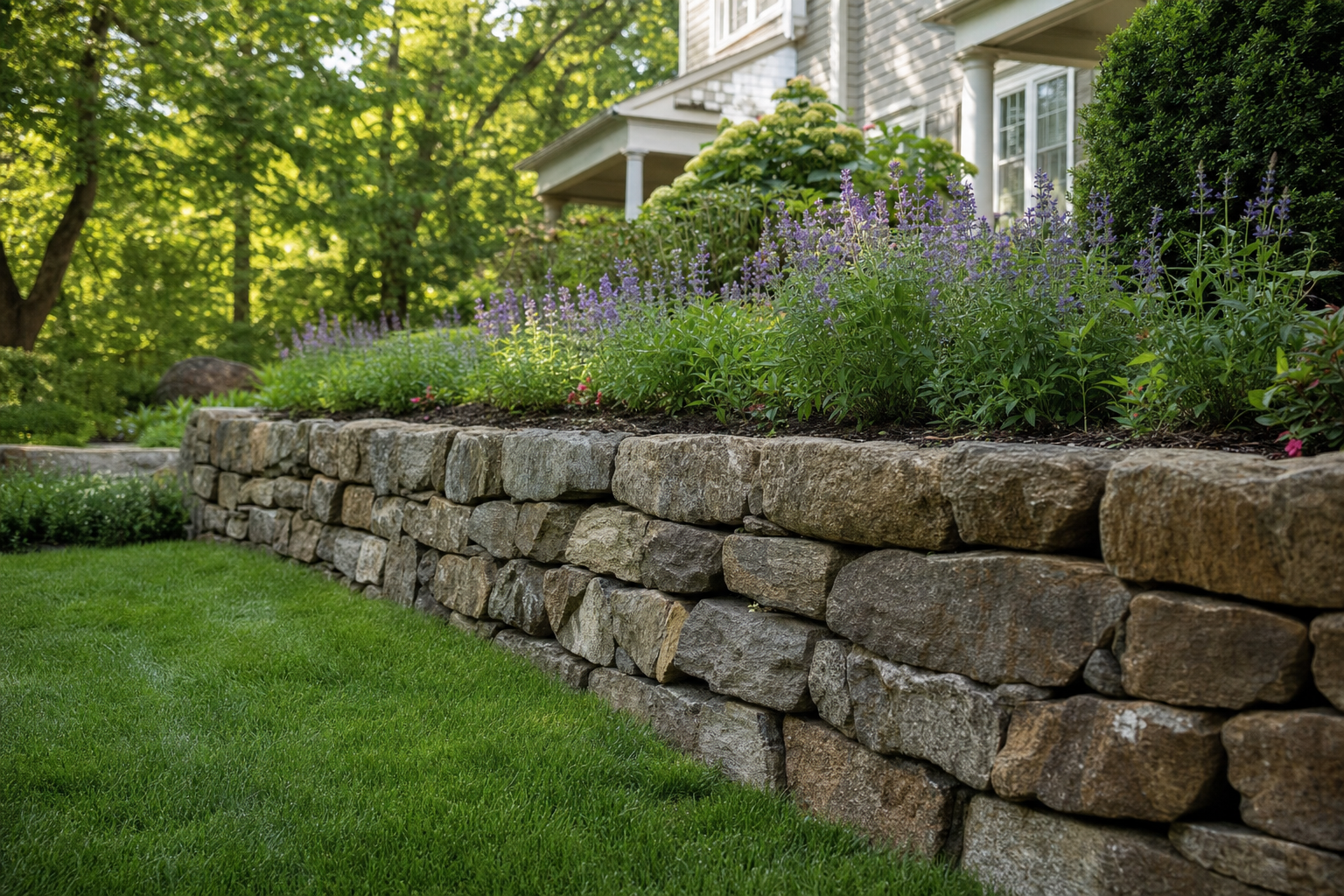
Material choice plays a large role in both the look and the structural behavior of the wall. Natural fieldstone suits older properties with a more traditional aesthetic, particularly along some of the historic corridors in Hopewell Borough. Segmental retaining block is more predictable in terms of engineering tolerances and works well on taller walls where load calculations matter. Timber walls are an option for shorter applications but have a shorter lifespan in Hopewell’s wet soil conditions. We walk through these options with every homeowner before any work begins, and our designs and renderings service lets you see how different wall types will look on your specific property before a single block is moved.
How Retaining Walls Fit Into a Hopewell Landscape Plan
A retaining wall rarely exists in isolation. On most of the sloped lots we work on in Hopewell, the wall is the anchor for a broader set of changes. Once grade is stabilized, the area above the wall often becomes usable outdoor space, which opens up possibilities for paver patios and walkways, landscape pathways, or plantings and softscapes that would not hold on an unretained slope. We have completed projects where a single retaining wall transformed a steeply pitched backyard into a functional outdoor living area with a kitchen or fireplace that the homeowner had wanted for years but could not place anywhere usable.
The area below the wall also needs attention. Redirecting the water that the wall is now blocking requires a plan, whether that means a drainage garden, a graded swale, or a piped system that carries runoff away from the foundation. We coordinate all of this as part of the same project so nothing gets left unresolved. You can get a sense of how we approach these integrated site plans by visiting our Hopewell service area page or our broader landscape design and installation overview.
For properties that also need site prep before wall construction can begin, our excavation services handle grading, clearing, and any lawn and property repairs needed after the structural work is complete.
Frequently Asked Questions
Do retaining walls in Hopewell, NJ require permits?
Most retaining walls above a certain height require a permit from Hopewell Township or Hopewell Borough, depending on where your property is located. The threshold and review process vary, so we confirm permit requirements during the site assessment phase before any work begins. Building without the appropriate permit can create issues at resale and may require the wall to be removed or modified.
How long does a retaining wall last in this area?
A properly built wall with adequate drainage behind it can last several decades. The biggest factor in premature failure in Hopewell is hydrostatic pressure from water that has nowhere to go. Walls built without drainage integration in this soil type tend to show movement within a few years. Material choice also plays a role, with natural stone and engineered segmental block generally outlasting timber in wet conditions.
Can a retaining wall help with my drainage problem?
A retaining wall can redirect and manage water movement on a sloped property, but it is not a standalone drainage solution. We typically pair walls with French drains, grading adjustments, or drainage gardens depending on where the water is coming from and where it needs to go. Treating the wall and the drainage as separate projects usually means addressing the drainage problem a second time after the wall is already in.
Do you serve areas near Hopewell, including Pennington and Princeton?
Yes. We work throughout the region, including Pennington, Princeton, and surrounding communities. Each area has its own site conditions, and we adjust our approach accordingly. Our service areas page covers the full list of communities we work in regularly.
Hopewell’s landscape is one of the more demanding we work in, and that is part of what makes it interesting. The Sourland ridgeline creates grade changes that few other areas in Mercer County can match, and the soil holds onto water in ways that keep every retaining-wall project honest. Getting it right here means building for what the ground actually does, not what a simpler site might allow. If your property has a grade or drainage concern, request a site visit to discuss a retaining-wall plan built for it.
